AI Operations Portfolio

Kelvin Mushele — AI operations and workflow automation

Ten years in FMCG sales, distribution and site operations, now building the automations I used to wish existed. I take a messy business process, make the rules explicit, automate the repetitive part, and keep a person in the loop wherever money or a customer relationship is at stake.

Background

Operations first, automation second

I spent over ten years in FMCG sales and account development, including route management and account development at Coastal Bottlers (Coca-Cola) and a sales officer role at Dutch Water Ltd. That work was daily reconciliation: orders against stock, deliveries against promises, and customers who noticed every gap.

In Qatar I worked in material security, stores and site operations with TRAGS, including oil and gas site exposure and permit receiver duties. Stores work teaches the same lesson as distribution: if the paperwork and the physical stock disagree, the paperwork is wrong.

I am now building practical AI automation on top of that experience. Not chatbots for their own sake — the boring, valuable parts: triaging enquiries so urgent ones are seen, keeping stock records that survive an audit, and making sure a serious lead does not sit unanswered behind a price request.

Everything on this page is something I built, ran and tested myself. The three projects below are portfolio work with synthetic data, not client deliveries, and each one states its own limitations.
Toolkit

What I actually use

Split honestly: tools I have used to build and ship something, and tools I am learning. Nothing here is listed because it looked good on a job advert.

Automation

Make (build specs) Zapier Webhooks Cron schedules

Code and data

Python SQL / SQLite REST APIs JSON Git

AI

Ollama DeepSeek Claude ChatGPT Prompt design

Business

Excel Google Sheets Stock control Route sales Process mapping

Learning

HubSpot API Docker Power BI

Portfolio

Three working automations

Each project has a runnable Python implementation, a Make scenario build specification, a dashboard generated from real run data, and tests. Each one states what it does not do.

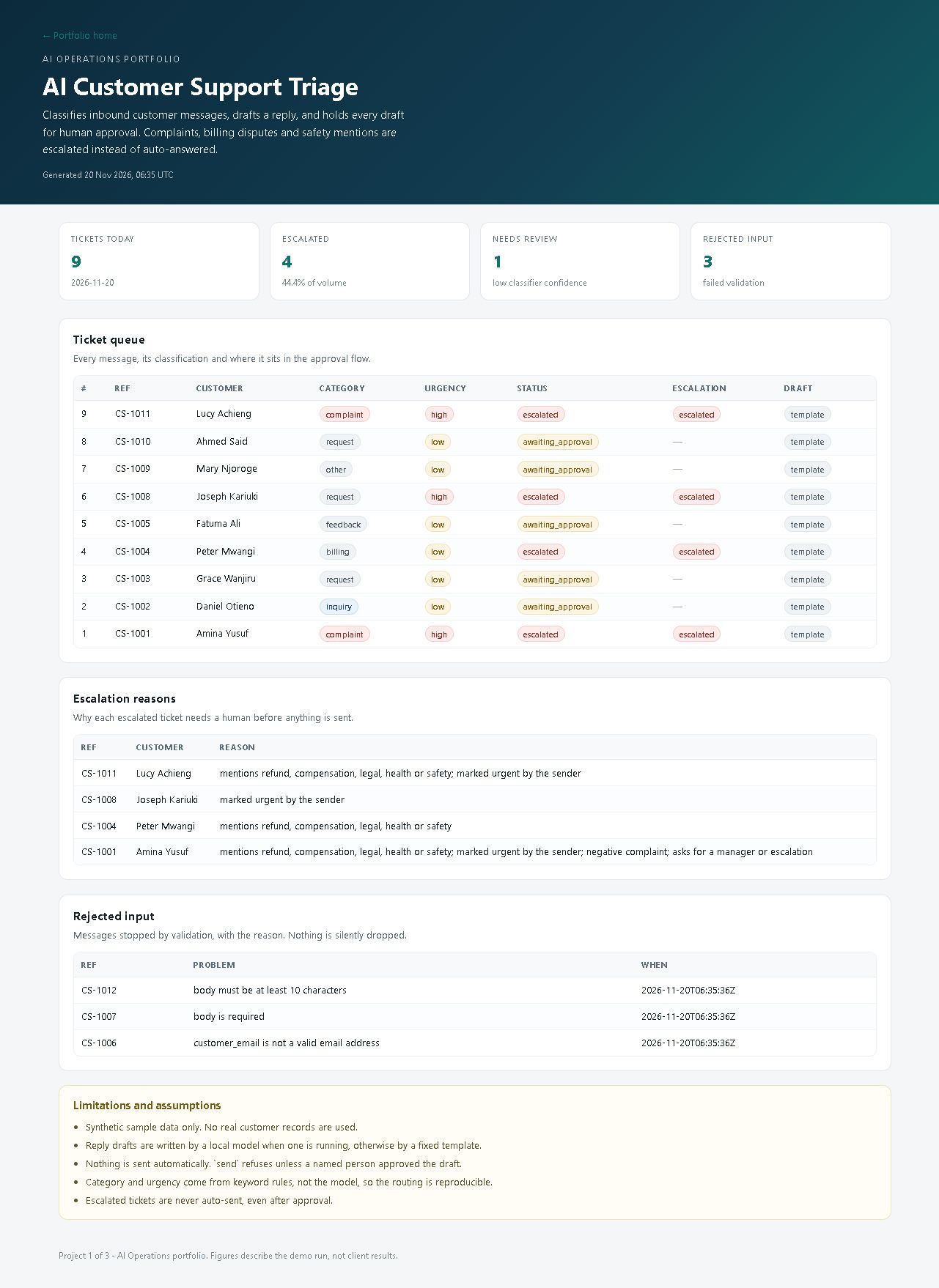
Project 01 · Customer support

AI customer support triage

Problem. A distributor answers the same questions all day. Routine enquiries queue behind urgent ones, and complaints about damaged or unsafe stock get answered by whoever is free, with no escalation rule.

Approach

Rules route, model writes

Escalation

Refund, legal, safety, urgent

Control

Human approval before send

Demo run

9 accepted, 4 escalated

Customer support triage dashboard showing ticket queue, escalation reasons and rejected input

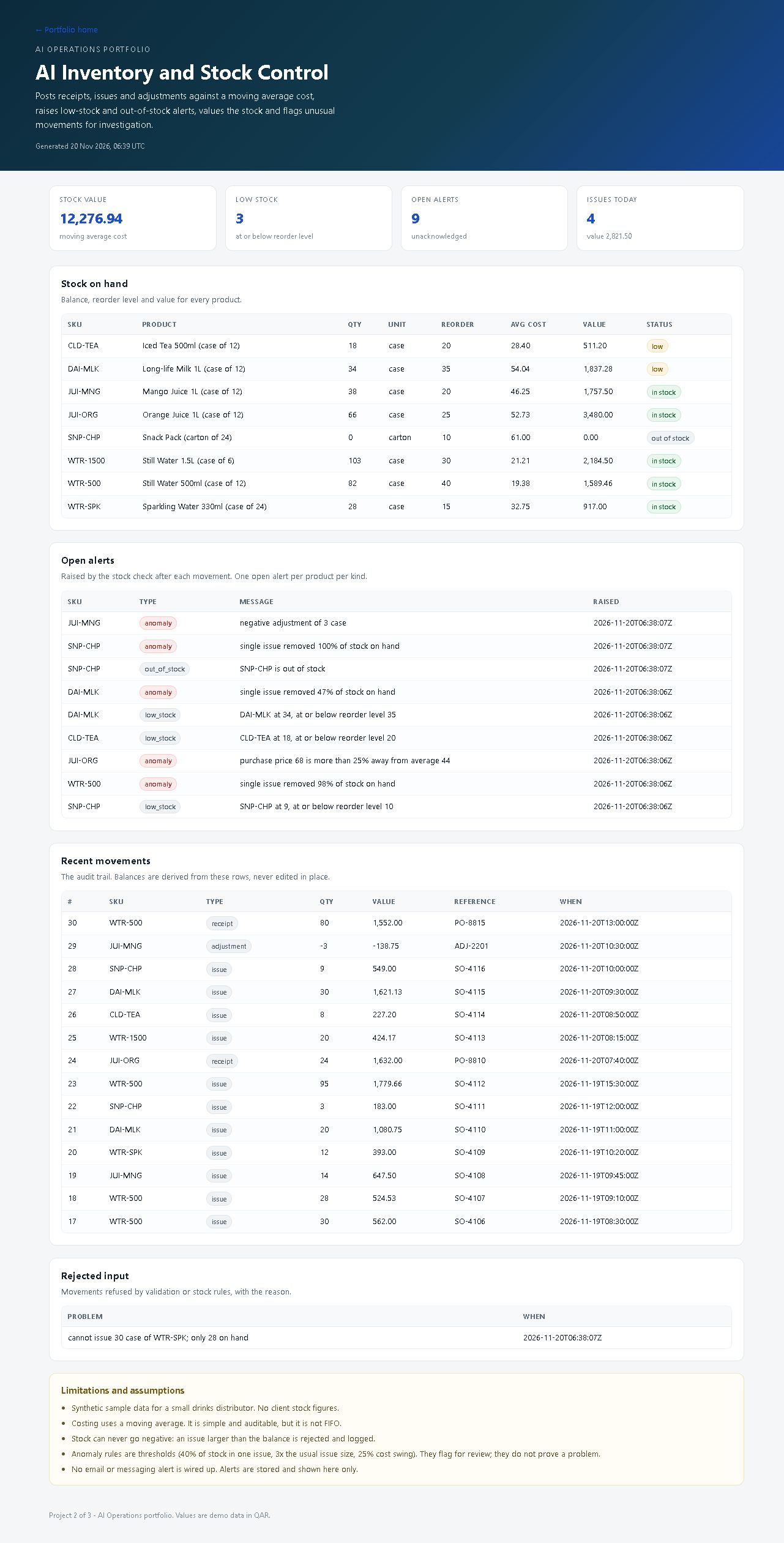
Project 02 · Inventory

AI inventory and stock control

Problem. Small distributors oversell stock they do not have, miss stockouts until a customer complains, and cannot explain shrinkage because records get edited in place.

Costing

Moving average

Audit trail

Every movement kept

Anomalies

4 explicit thresholds

Demo run

22 posted, 1 oversell refused

Inventory dashboard showing stock on hand, open alerts, recent movements and rejected input

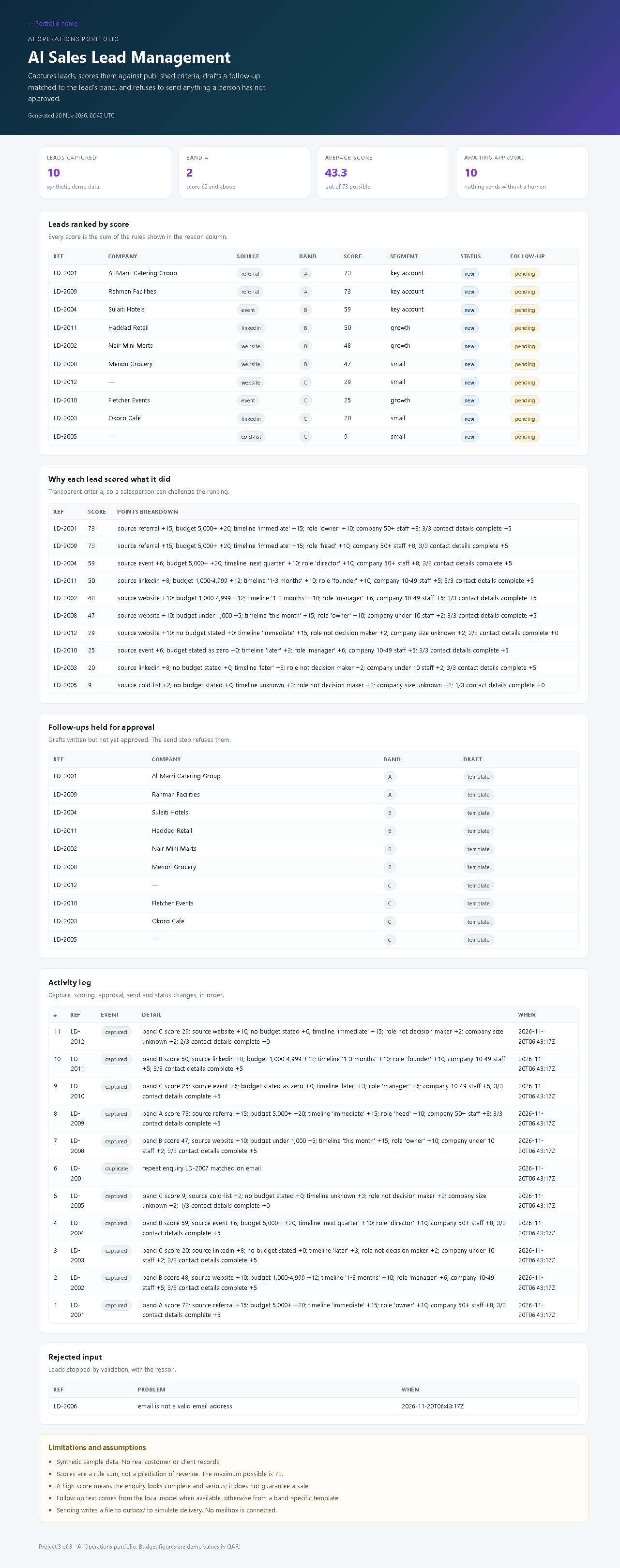
Project 03 · Sales

AI sales lead management

Problem. Every enquiry gets the same reply, so a forty-site contract waits behind a one-shop price request. The same buyer enquires twice, and nobody can say why one lead was chased and another was not.

Scoring

6 named rules, max 73

Deduplication

Reference and email

Wording

Band A / B / C

Demo run

10 leads, 2 in band A

Sales lead dashboard showing leads ranked by score, points breakdown and follow-ups awaiting approval

Evidence

What the tests actually cover

Every number below comes from running the code in this folder. The suite covers the happy path, invalid input, missing data, control failures and a parity check between the Python logic and the Make reference rules.

90

automated tests, all passing

3

Make scenario build specs

0

third-party Python packages

2

implementations cross-checked

What I am not claiming

  • These are portfolio projects with synthetic data, not paid client work.
  • No business results, savings or conversion figures are claimed. The demo numbers describe the demo.
  • The Make specs are validated structurally and their reference rules are executed with Node and cross-checked against the Python code. No scenario has been built or run inside Make.
  • The local model writes reply text. It does not make routing, scoring or escalation decisions, and the projects run without it.
  • I am not a senior AI engineer. I build practical automations, document them, and say where they stop.

Get in touch

Open to remote AI operations, automation and business operations roles, and to small automation projects. I am happy to walk through any project on a call and show the code running.

Location

Doha, Qatar · remote worldwide